
Cool-Season vs Warm-Season Grass: What Grows Where
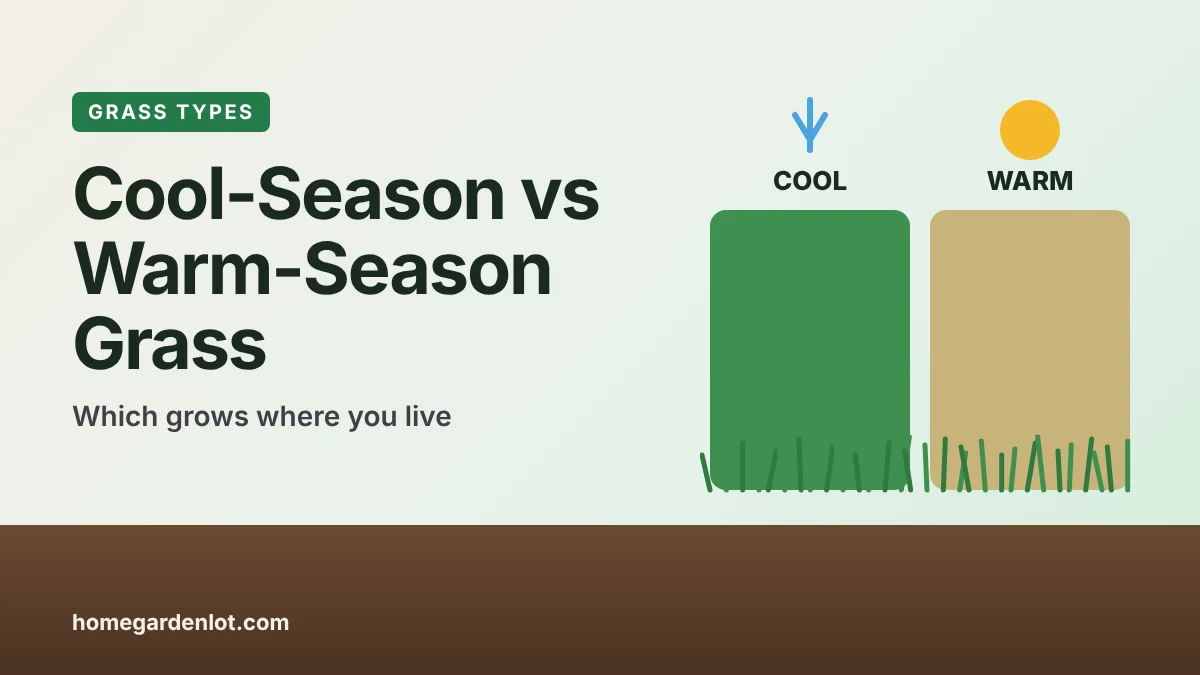
Cool-season grasses (Kentucky bluegrass, fescue, ryegrass) grow best at 60–75°F and suit the northern two-thirds of the US. Warm-season grasses (Bermuda, zoysia, St. Augustine, centipede) grow best at 80–95°F and suit the South. Cool types stay green through winter; warm types go tan after frost. The transition zone can grow either.
Choosing between cool-season and warm-season grass is the single biggest decision in lawn care, because everything else follows from it: when you seed, when you fertilize, how low you mow and how much water you use. Choose the wrong type for your climate and you fight the lawn every summer or every winter.
This guide compares the two groups, lists the main grasses in each, and shows how to pick one for your yard. Once you know your type, plan feeding with the lawn fertilizer calculator.
- Temperature: cool-season grows best at 60–75°F air temperature; warm-season at 80–95°F.
- Seasonal color: cool-season stays green in winter in mild areas; warm-season goes dormant and tan after frost.
- Where: cool-season across the North, warm-season across the South, either in the transition zone.
- Seeding time: cool-season in early fall; warm-season in late spring.
- Mixing them in one lawn is a recipe for patchwork; pick one and stick with it.
In this guide
- What is the difference between cool-season and warm-season grass?
- Which grasses are cool-season and warm-season?
- Where does each grass type grow in the US?
- How do the two types differ in care?
- Can you mix cool-season and warm-season grasses?
- What mistakes do homeowners make when choosing?
- How do you pick the right grass for your yard?
- Which type stays greener in a drought?
- What about the transition zone?
- Frequently asked questions
- The bottom line
What is the difference between cool-season and warm-season grass?
The difference is how each group photosynthesizes. Cool-season grasses use a pathway that is efficient in mild temperatures and slows down in heat. Warm-season grasses use a different pathway that thrives in heat and strong sun but shuts down when it gets cold. That one fact explains the differences in climate range, growth cycle, water use and color.
| Trait | Cool-season grass | Warm-season grass |
|---|---|---|
| Best growth temperatures | 60–75°F | 80–95°F |
| Peak growth | Spring and fall | Summer |
| Winter | Green in mild areas; dormant in hard freezes | Dormant and tan after frost |
| Summer heat | Can go dormant or thin | Thrives |
| Region | North, Upper Midwest, Pacific Northwest | Southeast, Gulf Coast, Southwest |
| Best seeding time | Late summer to early fall | Late spring to early summer |
| Main fertilizer window | Fall (September, November) | Late spring through summer |
Which grasses are cool-season and warm-season?
Here are the common home-lawn grasses, with typical mowing heights from university extension guidance. Heights vary by cultivar; your local extension office may publish a narrower range.
| Grass | Type | Mowing height | Shade tolerance | Best known for |
|---|---|---|---|---|
| Kentucky bluegrass | Cool | 2.5–3.5 in | Low–medium | Dense, self-repairing, rich color |
| Tall fescue | Cool | 3–4 in | Medium | Heat and drought tolerance among cool grasses |
| Perennial ryegrass | Cool | 2–3 in | Low | Fast germination, good wear tolerance |
| Fine fescues | Cool | 2.5–4 in | High | Shade and low-fertility soils |
| Bermudagrass | Warm | 1–2 in | Very low | Heat, drought and traffic tolerance |
| Zoysiagrass | Warm | 1–2.5 in | Medium | Dense turf, some cold tolerance |
| St. Augustinegrass | Warm | 2.5–4 in | Medium–high | Coastal and shady Southern lawns |
| Centipedegrass | Warm | 1–2 in | Low–medium | Low maintenance on acidic soils |
Once you know your grass type, plan its feeding. Open the lawn fertilizer calculator and enter your lawn size and bag numbers.
Where does each grass type grow in the US?
As a rough guide, cool-season grasses suit USDA hardiness zones 3–6, warm-season grasses suit zones 8–10, and zone 7 is the border. The practical band where either may be grown is called the transition zone, a wavy belt stretching from roughly the Mid-Atlantic coast through Virginia, Kentucky, Missouri and Kansas to northern Texas and parts of the Southwest.
| Region | Common choice | Notes |
|---|---|---|
| Northeast, Upper Midwest, mountain states | Kentucky bluegrass, fescue, ryegrass blends | Cold winters favor cool-season |
| Pacific Northwest | Fine fescue, ryegrass, bluegrass | Mild, moist climate suits cool-season |
| Transition zone | Tall fescue (cool) or zoysia / Bermuda (warm) | Each has weak seasons: summer for fescue, winter for warm types |
| Southeast and Gulf Coast | St. Augustine, Bermuda, centipede, zoysia | Hot summers favor warm-season |
| Desert Southwest | Bermuda | Needs irrigation; cool-season can be overseeded for winter color |
Your local extension office can tell you which grasses do best in your county. Soil, shade and irrigation matter as much as the map.
How do the two types differ in care?
Mowing and water
Cool-season grasses are generally mowed higher (about 2.5–4 inches), which shades the soil and keeps roots cool. Warm-season grasses tolerate close mowing, but need regular cutting during summer. Both need about 1 inch of water per week or more in summer; deep rooted tall fescue and Bermuda handle drought best.
Fertilizing
Cool-season lawns get their main feeding in fall; warm-season lawns get theirs in late spring and summer. Feeding at the wrong time wastes product and feeds weeds. A schedule by month is in our guide on when to fertilize your lawn, and the nitrogen rates are in the calculator.
Weeds and winter
Warm-season lawns go dormant and tan, which is normal but leaves bare-looking ground where winter weeds can sprout. Cool-season lawns face summer crabgrass instead. Neither is "better"; they simply have different weak seasons.
Can you mix cool-season and warm-season grasses?
You can, but you generally shouldn't. In a mixed lawn each type grows in its own season, so the lawn looks green in some areas and brown in others, and the two types need different mowing heights and fertilizer dates. The exception is overseeding dormant warm-season turf with ryegrass in the far South to keep it green through winter, a common practice that requires a deliberate plan.
What mistakes do homeowners make when choosing?
- Choosing by neighbor's lawn color in winter, not by how it performs over the year.
- Planting Bermuda in shade. It needs full sun.
- Seeding at the wrong time. Seed each type in its own growing season.
- Ignoring shade. Under heavy trees, fine fescues or St. Augustine beat Bermuda or bluegrass.
- Expecting winter green from warm-season grass. Dormancy is normal.
How do you pick the right grass for your yard?
Run through these five questions before buying seed or sod:
- What is your climate? Check your USDA zone and your county extension office's lawn recommendations.
- How much sun does the lawn get? Under 4 hours of direct sun needs shade-tolerant fine fescue or St. Augustine; Bermuda needs 6–8 hours or more.
- How much traffic? Kids and pets favor Bermuda, zoysia, perennial ryegrass and Kentucky bluegrass, which recover well.
- How much water and mowing will you accept? Tall fescue and Bermuda are drought tolerant; fine fescue needs little feed.
- Do you mind a tan winter? If not, warm-season grass in the South is the natural choice.
Which type stays greener in a drought?
Both groups can go dormant in a drought and recover when it rains, but warm-season grasses such as Bermuda and zoysia generally survive hot, dry spells with less water than cool-season grasses. Among cool-season grasses, tall fescue has deep roots and handles summer stress best, while Kentucky bluegrass and perennial ryegrass usually need more irrigation to stay green.
What about the transition zone?
Gardeners between zones 6 and 7 face the hardest choice. Cool-season grasses suffer in humid summer heat, with disease and thinning in July and August. Warm-season grasses turn brown for four to five months of winter and may be damaged by hard freezes. Tall fescue, zoysia and Bermuda are the most common choices, and extension offices in states like Virginia, Kentucky, Missouri and Arkansas publish specific recommendations by county.
Frequently asked questions
How can I tell what type of grass I have?
Look at when it greens up and when it browns. If it is green in cool weather and struggles in July heat, it is cool-season. If it turns tan after the first frost and wakes up in late spring, it is warm-season. Your county extension office can identify a sample.
What grass is best for the transition zone?
Tall fescue is the most common choice for low-maintenance lawns, while zoysia and Bermuda suit sunny, heat-tolerant lawns. Each fails in a different season, so choose by what you can live with.
Is warm-season grass lower maintenance than cool-season grass?
Not always. Warm-season grass often needs less water in summer but requires more frequent mowing and special care in winter. Cool-season grass may need more water in summer.
Which grass type stays green all year?
Cool-season grass stays green longest, especially in mild-winter areas. In the far South, warm-season lawns can be overseeded with ryegrass for green winter color.
Can I switch from cool-season to warm-season grass?
It's possible but requires removing the old turf and planting the new grass in its growing season. Check with your local extension service first, since the new grass must survive your winters.
The bottom line
Match your grass to your climate: cool-season grasses in the North and Northwest, warm-season grasses in the South, and a careful choice in the transition zone. Once you know the type, the calendar for seeding, feeding and mowing falls into place. Start with the lawn fertilizer calculator to plan your first feeding.
Related tools: Garden Calculator · Irrigation Runtime Calculator · Planting Calendar
Sources: Grass-type and mowing-height guidance from US university extension services, including Penn State Extension, North Carolina State Extension, Clemson Cooperative Extension and the University of Florida IFAS Extension; USDA Plant Hardiness Zone Map. Ranges vary by cultivar and state. Last reviewed: October 2026.
More Lawn Care guides
 What Do Fertilizer Numbers Mean? NPK Explained Simply
 How Long to Water Your Lawn: Sprinkler Run Times
 How Much Fertilizer per 1,000 Sq Ft? Pounds of Nitrogen
 How Much Grass Seed Do I Need? Rates by Grass Type
 How to Measure Your Lawn's Square Footage (Any Shape)
 When to Aerate Your Lawn: Timing, Tools and Steps