
When to Fertilize Your Lawn: Schedule by Grass Type
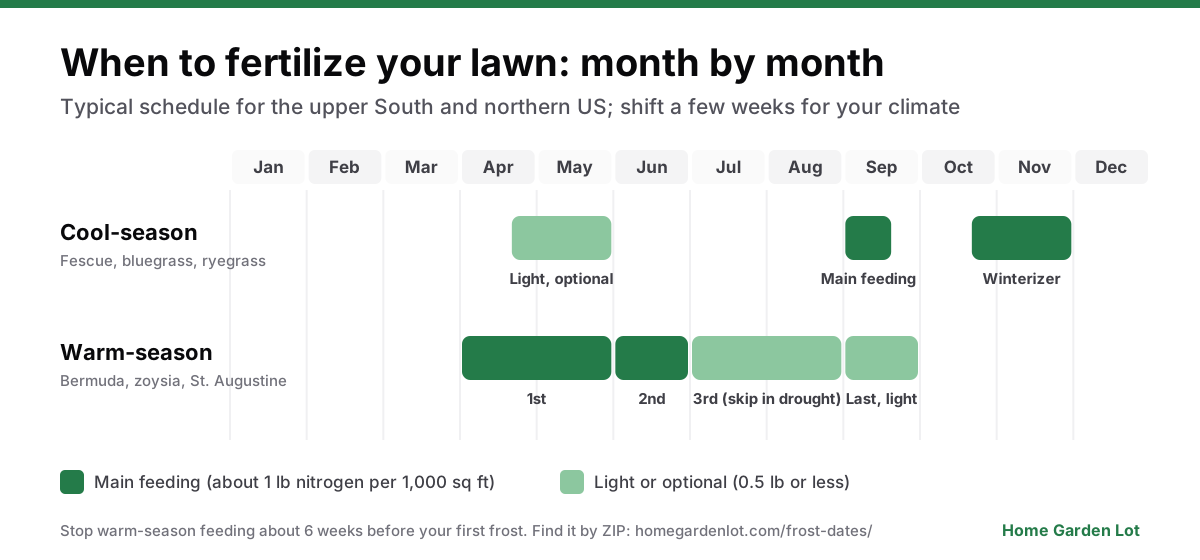
Fertilize cool-season lawns (Kentucky bluegrass, fescue, ryegrass) mainly in early fall and again in late fall. Fertilize warm-season lawns (Bermuda, zoysia, St. Augustine) from late spring through summer, once the grass is fully green. Skip both types during drought, dormancy and the heat of midsummer for cool-season grass.
Use the free Lawn Fertilizer Calculator: find how much of your fertilizer to spread at each feeding.
The right month to fertilize your lawn depends on one thing: which type of grass you have. Feed a cool-season lawn in July and you feed weeds and fungus. Feed a Bermuda lawn in October and you push growth right before frost. Timing it to the grass's growth cycle gives you thicker turf for less product.
This guide gives a month-by-month schedule for both grass types, how much to apply, and the mistakes that burn lawns. Once you know your dates, the lawn fertilizer calculator turns your lawn size and bag label into exact pounds of product.
- Cool-season grass: main feeding in September, a second in late October to November, and an optional light feeding in late spring.
- Warm-season grass: first feeding after full spring green-up, then every 6–8 weeks until about 6 weeks before first frost.
- Rate: 0.5–1 lb of nitrogen per 1,000 sq ft per application, never more than 1 lb of quick-release nitrogen at once.
- Yearly total: roughly 2–4 lb of nitrogen per 1,000 sq ft, depending on grass type and your state's extension advice.
- Soil test first: it tells you whether phosphorus or potassium are needed at all.
In this guide
- How do you know if you have cool-season or warm-season grass?
- When is the best time to fertilize a cool-season lawn?
- When is the best time to fertilize a warm-season lawn?
- How much nitrogen does each grass need per year?
- How do you fertilize a lawn step by step?
- Should you use slow-release or quick-release fertilizer?
- What mistakes make fertilizing burn or weaken a lawn?
- Frequently asked questions
- The bottom line
How do you know if you have cool-season or warm-season grass?
Cool-season grasses grow fastest when air temperatures are 60–75°F. They dominate the northern two-thirds of the US and stay green through winter in mild areas. Warm-season grasses grow fastest at 80–95°F, are common across the South, and turn tan after the first hard frost.
If your lawn greens up early in spring and looks its best in fall, you have cool-season grass. If it greens up late (after soil warms in April or May) and browns in winter, you have warm-season grass. In the transition zone (roughly from Virginia and Kentucky to Kansas and north Texas) both types are grown, so check what your neighbors' lawns do.
When is the best time to fertilize a cool-season lawn?
Cool-season grass puts its energy into roots and thickening in fall, which is why extension services such as Penn State and the University of Minnesota build the program around September and November. Spring feeding is lighter because heavy nitrogen in April pushes leaf growth just before summer stress.
| Month | What to do | Typical nitrogen |
|---|---|---|
| Late April–May | Light feeding, optional; slow-release is best | 0.5–1 lb per 1,000 sq ft |
| June–August | Usually none; stressed lawns can go dormant | 0–0.5 lb (slow-release only, if irrigated) |
| Early to mid September | Main feeding; pair with overseeding | 1 lb per 1,000 sq ft |
| Late October–November | "Winterizer" feeding while grass is still green, before the ground freezes | 1 lb per 1,000 sq ft |
A good rule for the second fall feeding: apply it after the last mowing is a few weeks away but before the ground freezes. Grass keeps absorbing nitrogen at soil temperatures above freezing, long after top growth slows.
When is the best time to fertilize a warm-season lawn?
Warm-season grass grows when soil is warm, so feed it when it is actively growing, not when it first wakes up. Wait until the lawn is mostly green and you have mowed it two or three times, usually late April to May in the upper South and March to April in the Gulf states.
| Month (upper South) | What to do | Typical nitrogen |
|---|---|---|
| April–May | First feeding after full green-up | 0.5–1 lb per 1,000 sq ft |
| June | Second feeding | 0.5–1 lb per 1,000 sq ft |
| July–August | Third feeding for Bermuda and zoysia; skip if drought-stressed | 0.5–1 lb per 1,000 sq ft |
| September (at most) | Last feeding, no later than about 6 weeks before first frost | 0.5 lb per 1,000 sq ft |
| October onward | None; late nitrogen can reduce winter hardiness | 0 |
In frost-free areas of Florida, Texas and the Gulf Coast, the growing season is longer, so the schedule can stretch. Local extension offices publish exact dates.
Know the month but not the amount? Use the lawn fertilizer NPK calculator. Enter your lawn size and the numbers on your bag to get pounds of product per application.
How much nitrogen does each grass need per year?
Total yearly nitrogen varies a lot by species. These are typical ranges per 1,000 sq ft per year for a home lawn, drawn from the general pattern in state extension guides. Your state's recommendation takes priority if it differs.
| Grass | Type | Typical lb N per 1,000 sq ft per year |
|---|---|---|
| Kentucky bluegrass | Cool | 2–4 |
| Tall fescue | Cool | 2–4 |
| Fine fescue | Cool | 1–2 |
| Perennial ryegrass | Cool | 2–4 |
| Bermudagrass | Warm | 3–5 |
| Zoysiagrass | Warm | 2–3 |
| St. Augustinegrass | Warm | 2–4 |
| Centipedegrass | Warm | Low; follow your state extension rate |
The lower end suits shady, clipped-and-returned (mulched) lawns and homeowners who want a low-maintenance yard. The upper end suits full-sun, high-traffic turf.
How do you fertilize a lawn step by step?
- Test your soil. A lab test from your county extension office costs little and tells you whether you need phosphorus, potassium or lime.
- Pick the product. Check the three numbers (N-P-K) on the bag. A bag that is 20% nitrogen contains 10 lb of nitrogen per 50 lb, which treats 10,000 sq ft at 1 lb per 1,000 sq ft.
- Mow first and apply to dry grass. Granules stick to wet blades and can burn them.
- Calibrate your spreader. Use the setting printed on the bag as a start, then check the output on a driveway tarp.
- Apply in two directions. Half the product going north to south, half east to west, avoids streaks.
- Sweep granules off hard surfaces back onto the lawn, and water in about 0.25–0.5 inch unless the label says otherwise.
Should you use slow-release or quick-release fertilizer?
Quick-release (water-soluble) nitrogen greens the lawn within days but wears off in 2–4 weeks and carries the highest burn risk. Slow-release nitrogen, such as polymer-coated urea or sulfur-coated urea, feeds for 6–12 weeks, allows a heavier single application and is far more forgiving if your spreader is not perfectly calibrated.
For most homeowners, a product that is at least 30–50% slow-release nitrogen is the safest choice for spring and summer feedings. Save the quick-release products for the fall feedings of cool-season grass, when you want a fast response and temperatures are mild. The bag lists the sources of nitrogen in the guaranteed analysis, so look for "slow-release" or "controlled-release" there.
What mistakes make fertilizing burn or weaken a lawn?
- Applying more than the label allows. More nitrogen does not mean greener grass; it means leaf burn and runoff.
- Feeding cool-season grass in summer heat. It encourages disease such as brown patch.
- Feeding warm-season grass too early. If roots are still waking up, weeds take the nitrogen.
- Mixing up weed-and-feed timing. Herbicide in the product needs to be applied when weeds are growing, which may not be the best fertilizing date.
- Skipping the soil test. Adding phosphorus to soil that already has plenty can be illegal in some states and harms waterways.
Frequently asked questions
Is it better to fertilize your lawn in spring or fall?
For cool-season grass, fall is better because the plant builds roots and stores energy for the next year. For warm-season grass, spring and summer are better, because that is when it grows.
Should I fertilize before or after rain?
Apply just before light rain or water it in afterward. Avoid applying before heavy rain, which can wash fertilizer into storm drains.
Can you fertilize a lawn too often?
Yes. Frequent heavy applications cause fast, weak growth, burn, thatch buildup and nutrient runoff. Stay at or below 1 lb of nitrogen per 1,000 sq ft per feeding.
What temperature is too cold to fertilize a lawn?
Do not apply to frozen ground. Cool-season grass can still take up nitrogen while soil is above freezing, but warm-season grass is dormant below about 55–60°F soil temperature and gets no benefit.
Do I need to fertilize a newly seeded lawn?
Yes. Use a starter fertilizer at seeding, then wait until the new grass has been mowed about four times before the first regular feeding.
The bottom line
Cool-season lawns want fertilizer in September and November; warm-season lawns want it from late spring through summer, ending about six weeks before frost. Keep each feeding to 1 lb of nitrogen per 1,000 sq ft or less, and let a soil test guide the rest. To turn your lawn size and bag label into pounds of product, use the lawn fertilizer calculator.
Related tools: Irrigation Runtime Calculator · Garden Calculator · Planting Calendar
Sources: Lawn fertilization guidance from US university extension services, including Penn State Extension, the University of Minnesota Extension, Clemson Cooperative Extension and the University of Florida IFAS Extension. Always confirm dates and rates with your state's extension office. Last reviewed: October 2026.
More Lawn Care guides
 Cool-Season vs Warm-Season Grass: What Grows Where
 What Do Fertilizer Numbers Mean? NPK Explained Simply
 How Long to Water Your Lawn: Sprinkler Run Times
 How Much Fertilizer per 1,000 Sq Ft? Pounds of Nitrogen
 How Much Grass Seed Do I Need? Rates by Grass Type
 How to Measure Your Lawn's Square Footage (Any Shape)